Msgr. Wadsworth Explains the Translation Process
FRONT ROYAL, Virginia, SEPT. 26, 2011 (Zenit.org).- The executive director of the International Commission on English in the Liturgy (ICEL) visited Christendom College last week to explain the steps involved in producing the new translation of the missal of the liturgy in English.
Theologian Msgr. Andrew Wadsworth, a priest of the Archdiocese of Westminster, England, readily acknowledged that the new translation is "more formal."
He explained that the use of formal English words reflected the quality and the characteristics of the original Latin text, and it also avoided regional differences that are more often found in colloquial phrasings.
"The difference that we have in our language, when we use it in an everyday way, does not exist to the same level when we move everything up a notch," the priest said. "When we move everything to a more formal register of the use of English, then we have a language that is common across regional and national boundaries."
Msgr. Wadsworth suggested that the current translation is "a bit flat": "The ideas are there, but they've sort of been squashed. In the new translation, they are re-inflated. They have something of the natural balance that is evident in the Latin.
"The phrases balance each other perfectly, the ideas are well presented, and you get a greater sense of what the prayer is about."
In his talk titled "The Making of the Missal," the commission director also explained the translation process, which he said was undertaken with "great care" and with the involvement of the bishops at each step.
He said that a base translator, who is accomplished in both linguistics and theology, initially translates each text. That translation is then evaluated by a team of four bishops, who present the text to the 11 bishops who serve ICEL. The text then goes to the 11 conferences that those bishops represent.
There, comments and recommendations are made, after which it is sent back to
ICEL. The commission makes adjustments to the translation and then it goes back to the 11 conferences for review. With a two-thirds majority vote, it is approved and sent to the Holy See.
Gregorian chant
Msgr. Wadsworth, an accomplished musician and leader of a choir that performs internationally, also noted that the new Missal contains more music that any other Missal in the history of the Church.
"The music is Gregorian chant -- with which I believe you are familiar," he said with a smile. "The Latin and the English sometimes appear side by side, which is a powerful way to reinforce that the singing of chant in Latin is perfectly alright in an English celebration of the Mass."
He went on to encourage students in their study of Latin, saying that the language is the "matrix" of much of western civilization and even more so of the Church -- particularly with sacred liturgy.
"The number of men and women who have the necessary command of the language is pitifully small at the present. It has dwindled," he said. "You are part of the new wave that's going to produce a new generation of scholars that will have not only these skills, but the sensibility to understand what the liturgy is about because you've been formed with Catholic theology. It is not sufficient to be a linguist. You have to be a linguist who understands the theology of the liturgy and who understands the truest purpose of the liturgy."
Concluding, Msgr. Wadsworth said that the purpose of the production of the English edition of the Missal -- and the guiding purpose in all of ICEL's activity -- is to create a dignified celebration of the sacred liturgy enabling all people to come to a greater experience of the saving mysteries that are celebrated.
The new translation of the Mass will be implemented in the United States on Nov. 27.
--- --- ---
On the Net:
To download the talk: http://christendom.edu/news/itunesu.php
Tuesday, September 27, 2011

Tuesday, September 6, 2011
We Are Catholic!
Thank you to my Plurk friend DefendUsInBattle for making and sharing this great video!
Friday, August 26, 2011
Cenaculum Mobilensis (What I Did on My Summer Vacation, or Latin Isn't as Dead as One Might Imagine)
Salvete omnes!
I spent the first week of August at Visitation Monastery in Mobile, Alabama, where I participated in the annual Latin Immersion Cenaculum of the Familia Sancti Hieronymi, The Invitatio stated, "Come for the good of Holy Mother Church, for the good of Catholic Culture, and for your own good." This simple summary of the experience of the Cenaculum, while very true and succinct, does not do justice to the actual experience of the week.
Latin was the language of the week. Everything, and I mean everything, was spoken in Latin. We were about 30 participants who came together from several states in the US, as well as other countries, children and adults, laity and clergy. We ranged in our Latin ability from beginner to advanced, with both ecclesial and classical pronunciation. (listening to the classicist was like trying to decipher an accent! lol) We heard two lectures each morning and one in the afternoon. In addition, each afternoon a fun session was held for the tiro (beginner), which helped overcome hesitancy in conversation. The adulescentes had brought their sports equipment, and every afternoon they played pugnifollis, AKA volleyball! In the evenings, we were treated to various slide shows of religious sites in Italy and Sicily. EWTN sent someone to film one of the days, and some of the participants were interviewed. The last evening was the Celebrandi, kind of a group participation variety event. Each participant could get up and sing, dance, play the piano, recite a poem, or whatever (in lingua Latina, of course!).
However, the week did not consist only of lectures, games, and conversation. It truly was a retreat. We assembled in the historic Arts and Crafts style chapel four times each day for the chanted Liturgium Horarium in alternatum. After Morning Prayer (Matitudinem), the Holy Sacrifice of the Mass was sung in either the Extraordinary or Ordinary form. Midday Prayer (Sextem) was followed by the recitation of the Sanctum Rosarium. Two of the Vespers (Vesperum) services were Solemn, for the Feast of the Transfiguration and for Second Vespers of Sunday. Night Prayer (Completorium) was followed by the Office of Readings(Lectionis). Each evening concluded with Adoration of the Most Blessed Sacrament and Benediction.
Each meal was preceeded by the Angelus and the traditional Grace Before Meals.
For my schola cantorum buddies, here is a list of (mostly) what we chanted:
Missa IX, Missa II, Missa XII(?), Missa de Angelis, Missa Orbis Factor
Credo I, Credo IV
The actual appointed Propers for each Mass!
At Benediction each night, we sang a few selections from the booklet Jubilate Deo:
Magnificat
Da Pacem
Te Deum
O Salutaris
Ubi Caritas
Tu Es Petrus
Ave Maris Stella
Tantum Ergo
Adoro Te Devote
Laudate
The schola also sang a Palestrina motet at one of the Masses, but I did not write down the name of it. The chanting of the Solemn Vespers used an assortment of Modes 3-8.
Pictures:

at the Celebrandi
posted by Domina Gaudia!
I spent the first week of August at Visitation Monastery in Mobile, Alabama, where I participated in the annual Latin Immersion Cenaculum of the Familia Sancti Hieronymi, The Invitatio stated, "Come for the good of Holy Mother Church, for the good of Catholic Culture, and for your own good." This simple summary of the experience of the Cenaculum, while very true and succinct, does not do justice to the actual experience of the week.
Latin was the language of the week. Everything, and I mean everything, was spoken in Latin. We were about 30 participants who came together from several states in the US, as well as other countries, children and adults, laity and clergy. We ranged in our Latin ability from beginner to advanced, with both ecclesial and classical pronunciation. (listening to the classicist was like trying to decipher an accent! lol) We heard two lectures each morning and one in the afternoon. In addition, each afternoon a fun session was held for the tiro (beginner), which helped overcome hesitancy in conversation. The adulescentes had brought their sports equipment, and every afternoon they played pugnifollis, AKA volleyball! In the evenings, we were treated to various slide shows of religious sites in Italy and Sicily. EWTN sent someone to film one of the days, and some of the participants were interviewed. The last evening was the Celebrandi, kind of a group participation variety event. Each participant could get up and sing, dance, play the piano, recite a poem, or whatever (in lingua Latina, of course!).
However, the week did not consist only of lectures, games, and conversation. It truly was a retreat. We assembled in the historic Arts and Crafts style chapel four times each day for the chanted Liturgium Horarium in alternatum. After Morning Prayer (Matitudinem), the Holy Sacrifice of the Mass was sung in either the Extraordinary or Ordinary form. Midday Prayer (Sextem) was followed by the recitation of the Sanctum Rosarium. Two of the Vespers (Vesperum) services were Solemn, for the Feast of the Transfiguration and for Second Vespers of Sunday. Night Prayer (Completorium) was followed by the Office of Readings(Lectionis). Each evening concluded with Adoration of the Most Blessed Sacrament and Benediction.
Each meal was preceeded by the Angelus and the traditional Grace Before Meals.
For my schola cantorum buddies, here is a list of (mostly) what we chanted:
Missa IX, Missa II, Missa XII(?), Missa de Angelis, Missa Orbis Factor
Credo I, Credo IV
The actual appointed Propers for each Mass!
At Benediction each night, we sang a few selections from the booklet Jubilate Deo:
Magnificat
Da Pacem
Te Deum
O Salutaris
Ubi Caritas
Tu Es Petrus
Ave Maris Stella
Tantum Ergo
Adoro Te Devote
Laudate
The schola also sang a Palestrina motet at one of the Masses, but I did not write down the name of it. The chanting of the Solemn Vespers used an assortment of Modes 3-8.
Pictures:
 |
| Cenaculum participants (missing a few!) |
 |
| Liturgium Horarum |
 |
| Angelus |
  |
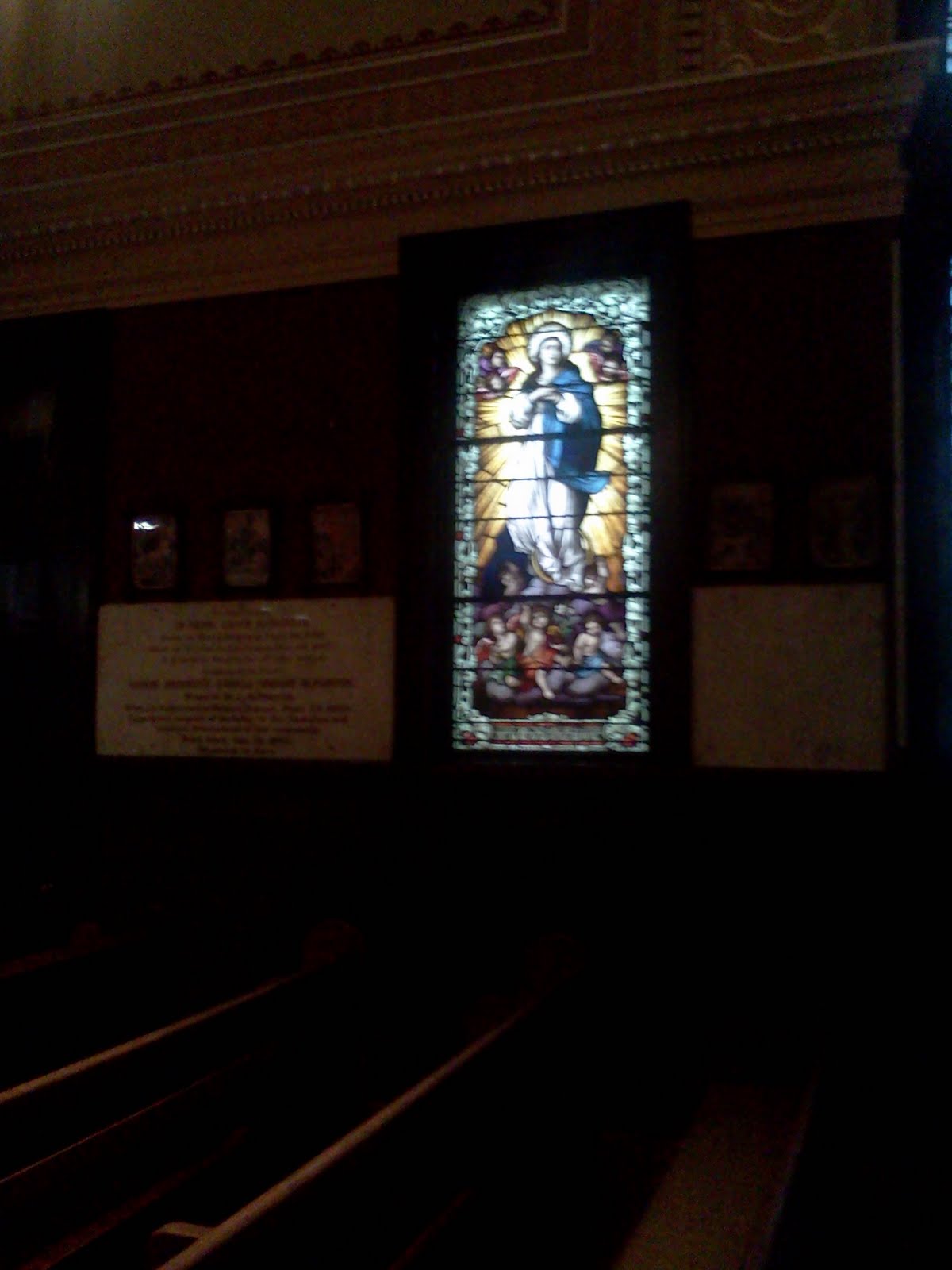
stained glass windows |
 |
| Tabernacle and Privileged Altar |
at the Celebrandi
posted by Domina Gaudia!
Saturday, June 18, 2011
Saint Faustina's Prayer for Holy Church and for Priests

Lord, give us holy priests; You Yourself maintain them in holiness. O Divine and Great High Priest, may the power of Your mercy accompany them everywhere and protect them from the devil's traps and snares which are continually being set for the souls of priests. May the power of Your mercy, O Lord, shatter and bring to naught all that might tarnish the sanctity of priests, for You can do all things. I ask You, Jesus, for a special blessing and for light for the priests before whom I will make my confessions throughout my lifetime. Amen.
Source: Posted on the Franciscan_Spirit mailing list on May 12, 2003 by Nadine Mansour; also as prayer # 7 in: Chalice of Strength, pages 17-18. Crusade for Priests, Detroit, Michigan, 1996. (www.opusangelorum.org).
http://www.paxetbonum.net/pfp2.html#40

Sunday, June 12, 2011
Pentecost 2011
 |
| Congratulations to the Church in Australia, who has begun on this day the new translation of the Mass! Acts 2: 1-4 (Douay-Rheims Bible) 1 AND when the days of the Pentecost were accomplished, they were all together in one place: 2 And suddenly there came a sound from heaven, as of a mighty wind coming, and it filled the whole house where they were sitting. 3 And there appeared to them parted tongues as it were of fire, and it sat upon every one of them: 4 And they were all filled with the Holy Ghost, and they began to speak with divers tongues, according as the Holy Ghost gave them to speak.  |
Sunday, May 8, 2011
Happy Mother's Day, we have a winner!
Congratulations to Ruby A., the winner of the
OQuamGloriosum
Mother's Day toddler mantilla giveaway!
 |
| toddler mantilla, doll not included |
Happy Mother's Day to all our contestants, and the myriad of OQG blog readers! ;)
Sunday, May 1, 2011
Vigil Prayer to Our Lady prayed by Pope Benedict & written by John Paul II
Pope Benedict XVI closed the prayer vigil tonight on the eve of John Paul II's beatification with this beautiful Marian prayer:
PRAYER TO OUR LADY OF LOURDES
Hail Mary, poor and humble Woman, Blessed by the Most High! Virgin of hope, dawn of a new era, We join in your song of praise, to celebrate the Lord’s mercy, to proclaim the coming of the Kingdom and the full liberation of humanity.
Hail Mary, lowly handmaid of the Lord, Glorious Mother of Christ! Faithful Virgin, holy dwelling-place of the Word, Teach us to persevere in listening to the Word, and to be docile to the voice of the Spirit, attentive to his promptings in the depths of our conscience and to his manifestations in the events of history.
Hail Mary, Woman of sorrows, Mother of the living! Virgin spouse beneath the Cross, the new Eve, Be our guide along the paths of the world. Teach us to experience and to spread the love of Christ, to stand with you before the innumerable crosses on which your Son is still crucified.
Hail Mary, woman of faith, First of the disciples! Virgin Mother of the Church, help us always to account for the hope that is in us, with trust in human goodness and the Father’s love. Teach us to build up the world beginning from within: in the depths of silence and prayer, in the joy of fraternal love, in the unique fruitfulness of the Cross.
Holy Mary, Mother of believers, Our Lady of Lourdes, pray for us.
Amen.
PRAYER TO OUR LADY OF LOURDES
Hail Mary, poor and humble Woman, Blessed by the Most High! Virgin of hope, dawn of a new era, We join in your song of praise, to celebrate the Lord’s mercy, to proclaim the coming of the Kingdom and the full liberation of humanity.
Hail Mary, lowly handmaid of the Lord, Glorious Mother of Christ! Faithful Virgin, holy dwelling-place of the Word, Teach us to persevere in listening to the Word, and to be docile to the voice of the Spirit, attentive to his promptings in the depths of our conscience and to his manifestations in the events of history.
Hail Mary, Woman of sorrows, Mother of the living! Virgin spouse beneath the Cross, the new Eve, Be our guide along the paths of the world. Teach us to experience and to spread the love of Christ, to stand with you before the innumerable crosses on which your Son is still crucified.
Hail Mary, woman of faith, First of the disciples! Virgin Mother of the Church, help us always to account for the hope that is in us, with trust in human goodness and the Father’s love. Teach us to build up the world beginning from within: in the depths of silence and prayer, in the joy of fraternal love, in the unique fruitfulness of the Cross.
Holy Mary, Mother of believers, Our Lady of Lourdes, pray for us.
Amen.
Subscribe to:
Posts (Atom)